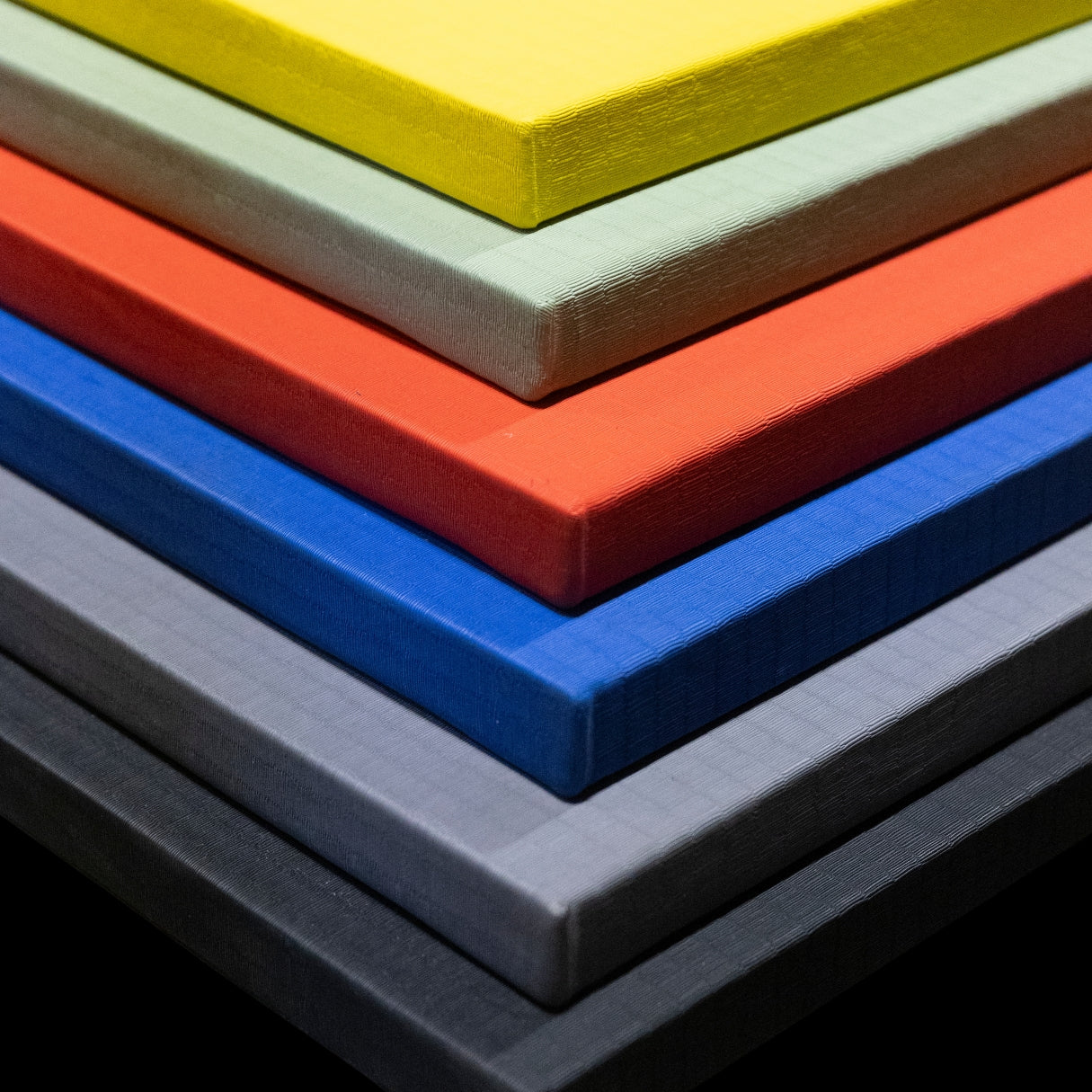


Best BJJ Mats in 2026: What to Look For and What the Pros Use
If you're shopping for BJJ mats in 2026, you've probably already discovered the problem: there are dozens of options, the price range is enormous, and the advice online is often written by people who've never rolled on a mat in their lives. This guide cuts through the noise.
We'll cover what actually matters when buying BJJ mats — surface type, thickness, size, and density — and share what professional academies across the USA are putting on their floors right now.
The Two Surface Choices: Tatami vs Smooth
This is the first decision you'll make, and it matters more than most people realize.
Smooth Surface Mats
Smooth surface mats are the preferred choice for no-gi BJJ. The surface reduces friction, which means fewer mat burns during long rolling sessions. Top-level competitors training at high-volume academies often prefer this surface because it allows faster movement on the ground and extends the lifespan of their skin during daily training.
The trade-off: smooth mats provide less grip for the feet. Academies that run barefoot striking classes or wrestling sessions alongside BJJ may find students slipping more than they'd like.
Tatami Surface Mats
Tatami mats have a textured surface that provides significantly more traction. They're the dominant choice for gi BJJ, judo, and any academy running a multi-discipline program. Many academies that teach both gi and no-gi simply choose tatami as their all-purpose surface.
The bottom line: if you're building a dedicated no-gi BJJ room, go smooth. For everything else — gi, mixed curriculum, or if you're unsure — tatami is the safer choice.
Thickness: 1 5/8" vs 2"
The two most common thicknesses for BJJ mats are 1 5/8 inch (4 cm) and 2 inch (5 cm).
1 5/8 inch is the industry standard for most BJJ academies. It provides enough cushioning for takedowns and falls while remaining firm enough for footwork, standing guard passing, and seated movements. The vast majority of professional academies in the USA use this thickness.
2 inch mats are preferred in academies where throws are a significant part of the curriculum (judo crossover programs, wrestling, self-defense classes), or where the subfloor is harder than ideal. The extra half-inch adds meaningful fall protection at the cost of a slightly softer surface feel.
Unless your program has a strong throwing component, 1 5/8 inch is the right call for a BJJ-focused academy.
Mat Size and Layout
Matsuru mats are 2m x 1m (approximately 6.5 ft x 3.3 ft). This is a common international standard that simplifies ordering and layout calculations.
For a typical competition-sized mat area (10m x 10m), you'd need approximately 50 mats. A smaller training room at 6m x 8m needs around 24 mats. Always buy 5–10% extra to account for edge trimming and future expansion.
Lay mats in a brick pattern — each row offset by half a mat length — to distribute stress across the seams and prevent mats from separating during training. This is the installation method used by professional academies worldwide.
What Professionals Use
When we look at professional BJJ academies across the USA, a few patterns emerge:
- Competition-focused academies tend to run smooth surface mats in training rooms to mirror competition conditions, with tatami mats in warm-up and kids' areas
- Multi-discipline academies almost universally go tatami — it works for gi BJJ, MMA, wrestling, and judo on the same surface
- Academies with hardwood subfloors sometimes add a thin rubber base layer under tatami mats for extra vibration dampening, though Matsuru's foam-core mats are engineered to perform without one
Matsuru mats are used in hundreds of academies across North America. One coach put it simply: "I've used cheaper mats and I've used Matsuru. The difference in durability alone makes Matsuru worth it."
What to Avoid
A few things to watch for when comparing mat options:
- Puzzle mats for serious training — interlocking foam puzzle mats are fine for home gyms and light drilling, but they shift and separate under live rolling and cannot handle the volume of a real academy
- Unknown foam density — cheaper mats often don't disclose their foam density (measured in kg/m³). Matsuru mats use a high-density foam core that maintains its shape and cushioning over years of heavy use
- Thin vinyl covers — the cover material determines how the mat feels and how long it lasts. Matsuru uses a durable vinyl that resists scuffs, disinfectant cleaning, and UV degradation better than bargain alternatives
The Cost of Getting It Wrong
New gym owners often make the mistake of buying the cheapest mats available to save money upfront. Within 12–18 months, the seams are separating, the foam is compressing unevenly, and the surface is cracking. The replacement cost — plus the downtime of having to re-floor the gym — ends up being more expensive than buying quality mats the first time.
Matsuru mats are designed for the long term. With proper care, they last well beyond typical replacement cycles at comparable-priced products.
How to Order
Matsuru ships to all 50 US states from its Arlington, WA warehouse. To get started:
- Browse the full mat collection
- Use the free 3D gym designer to calculate your mat count
- For orders of 50+ mats, request a custom quote for volume pricing
Have questions about which mat is right for your academy? Our team is happy to walk you through the options. Get in touch here.


